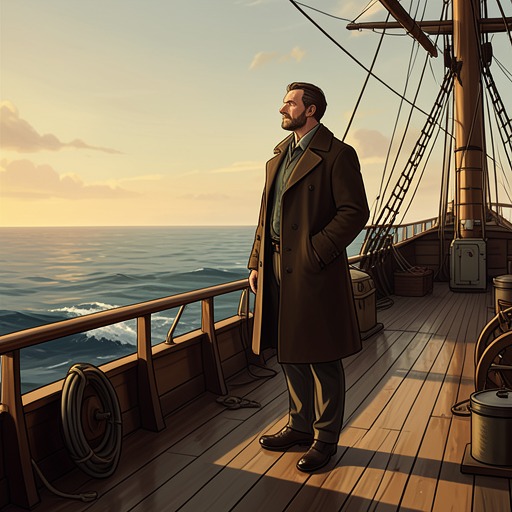
Joseph Banks
The WhaleJoseph Banks is presented as a naturalist whose work connected exploration and scientific institutions with the practical knowledge gathered at sea. His appearances range from receiving the young William Scoresby in London to recording a Killer whale chase in the Thames and presenting research that clarified the origins of ambergris.
Naturalist and Scientific Patron
Banks is described as a renowned naturalist who had sailed with James Cook. When William Scoresby came to see him after studying science in Edinburgh and serving in the navy, Banks received him at his house in Soho Square. Scoresby spoke eloquently about the Arctic regions he had explored on his father’s whaling voyages; the account suggests that Banks may have recognized something of his own younger self in the visitor.
That meeting placed Banks at a junction between established scientific authority and observations made on whaling voyages. Scoresby’s experience of the Arctic was not merely a subject of conversation: after taking command of the Resolution and then the Esk, he sent Banks findings from his journeys, including his investigations of the temperature of the sea below its surface.
Measuring the Ocean
Banks and Scoresby developed the Marine Diver to measure the ocean’s residual heat more accurately. The brass instrument could be lowered 7,000 feet into the water, extending scientific measurement into depths that ordinary observation could not reach. For Scoresby, whaling helped finance his investigations; Banks’s collaboration helped turn those investigations into a more precise instrument.
The work also linked scientific inquiry to the hazards and routines of a whaling voyage. While Scoresby’s ship faced peril in pack ice, his notes and observations accumulated into a record of Arctic seas. His later account of the Arctic became a wide-ranging reference on cetology, whaling techniques, and the region’s natural conditions, illustrating the broader knowledge to which Banks’s support contributed.
Recording a Thames Pursuit
Banks also appears as a recorder of encounters between whales and London’s river. In 1793, a thirty-foot Killer whale entered the Thames and, after being harpooned, was pursued from Deptford to Greenwich, towing its hunters at speed. Banks recorded the episode; the whale’s skull subsequently entered the collection of the Royal College of Surgeons.
The account places this pursuit among a series of whale encounters in the river, where animals that entered a heavily inhabited waterway were treated as spectacles, quarry, or sources of specimens. Banks’s role here is specifically documentary: the evidence identifies him as the recorder, not as a participant in the chase.
Ambergris and Scientific Explanation
In 1783 Banks presented a paper to the Royal Society by the German doctor Franz Xavier Schwedier that conclusively identified the true origins of ambergris. The finding addressed a substance long surrounded by uncertainty and prized for its rarity. Banks’s part was to bring Schwedier’s account before a scientific institution, connecting research on a whale-derived material with formal public discussion.
The subject also had a substantial commercial life. In 1791, a whale brought from the South Seas aboard the Lord Hawkesbury was reported to contain nearly four hundred ounces of ambergris, which sold at Lloyd’s Coffee-house for nineteen shillings and sixpence an ounce. The record of Banks’s presentation and the later report of a high-value sale frame ambergris as both a scientific question and a valuable commodity, while locating Banks within the networks through which such knowledge was examined and circulated.